UK Tyre Size Comparison Guide: Width, Profile & MOT Rules
Direct Answer: Selecting alternative tyres or upgrading alloy wheels requires calculating overall diameter differences to ensure your speedometer stays accurate and your vehicle remains fully compliant with UK MOT regulations. Changing tyre sizes alters your rolling circumference, directly impacting speed readings, engine gearing, fuel efficiency, and wheel-arch clearance. Maintaining an overall diameter difference within a ±2.5% tolerance range preserves factory safety calibration while keeping your speedometer within legal margins.
How Do You Read UK Tyre Sidewall Markings?
Tyre sidewall markings display standardized alphanumeric codes that define the physical dimensions, structural design, and load capabilities of the tyre. For example, on a standard 205/55 R16 91V tyre:
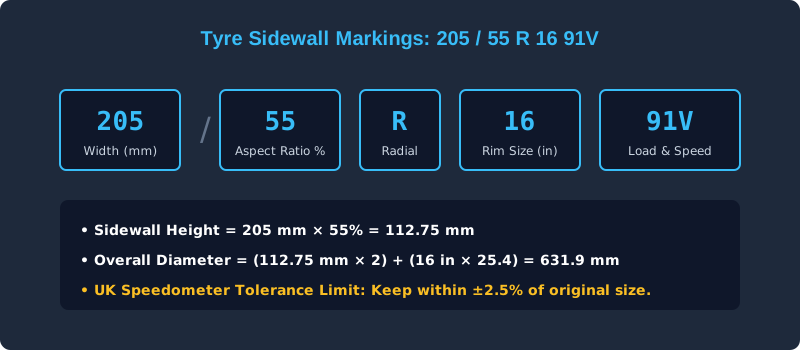
- 205 (Section Width): The width of the tyre measured in millimetres from sidewall to sidewall across its widest point when mounted on the recommended rim.
- 55 (Aspect Ratio / Profile): The height of the sidewall expressed as a percentage of the section width. Here, sidewall height is 55% of 205 mm, equal to 112.75 mm.
- R (Construction): Indicates Radial construction, where internal ply cords run perpendicularly across the tread to reinforce structure.
- 16 (Wheel Diameter): The diameter of the wheel rim in inches that the tyre fits.
- 91 (Load Index): A numerical code representing maximum weight capacity (91 corresponds to 615 kg per tyre).
- V (Speed Rating): A letter code indicating the maximum safe speed capability (V permits speeds up to 149 mph).
How Does Tyre Size Affect Speedometer Accuracy?
Changing wheel rim sizes or tyre profiles alters the rolling circumference of the wheel assembly, directly distorting speedometer accuracy. The speedometer calculates vehicle velocity based on drive-shaft rotations; larger tyres travel farther per rotation, making the speedometer display a lower speed than the vehicle's true velocity.
Formula for Tyre Overall Diameter: Overall Diameter = (Section Width × Aspect Ratio % × 2) + (Rim Diameter × 25.4)
For instance, fitting a 225/45 R17 tyre to replace a factory 205/55 R16 changes the overall diameter from 631.9 mm to 634.3 mm (+2.4 mm or +0.38%). At a true speed of 60 mph, the speedometer will display 59.8 mph.
Under UK Road Vehicles (Construction and Use) Regulations, speedometers must never under-read. Changing tyres beyond a ±2.5% diameter tolerance risks illegal speedometer readings and can cause recalibration errors with Anti-lock Braking Systems (ABS) and Electronic Stability Programmes (ESP).
What Are the UK MOT Rules on Tyre Sizes and Axle Matching?
The UK Ministry of Transport (MOT) test enforces strict requirements regarding tyre dimensions, condition, and structural consistency across vehicle axles.
Axle Matching Requirements
- Identical Size per Axle: Tyres fitted on the same axle must share the same nominal section width, aspect ratio, and diameter. Mixing different sizes across the same axle results in an immediate MOT failure.
- Matching Construction Type: You cannot mix radial tyres with cross-ply tyres on the same axle. Radial tyres must be fitted across both front and rear axles on modern passenger cars.
Tyre Size Equivalence Comparison Table
| Original Size | Replacement Size | Original Diameter | New Diameter | Diameter Difference | Speedo at 60 mph | MOT Compliant? |
|---|---|---|---|---|---|---|
| 205/55 R16 | 225/45 R17 | 631.9 mm | 634.3 mm | +0.38% (+2.4 mm) | 59.8 mph | Yes (if pair matched) |
| 205/55 R16 | 225/40 R18 | 631.9 mm | 637.2 mm | +0.84% (+5.3 mm) | 59.5 mph | Yes (if pair matched) |
| 195/65 R15 | 205/55 R16 | 634.5 mm | 631.9 mm | -0.41% (-2.6 mm) | 60.2 mph | Yes (if pair matched) |
| 215/55 R17 | 235/45 R18 | 668.3 mm | 668.7 mm | +0.06% (+0.4 mm) | 60.0 mph | Yes (if pair matched) |
| 205/55 R16 | 215/65 R16 | 631.9 mm | 685.9 mm | +8.55% (+54 mm) | 55.3 mph | NO (Exceeds 2.5%) |